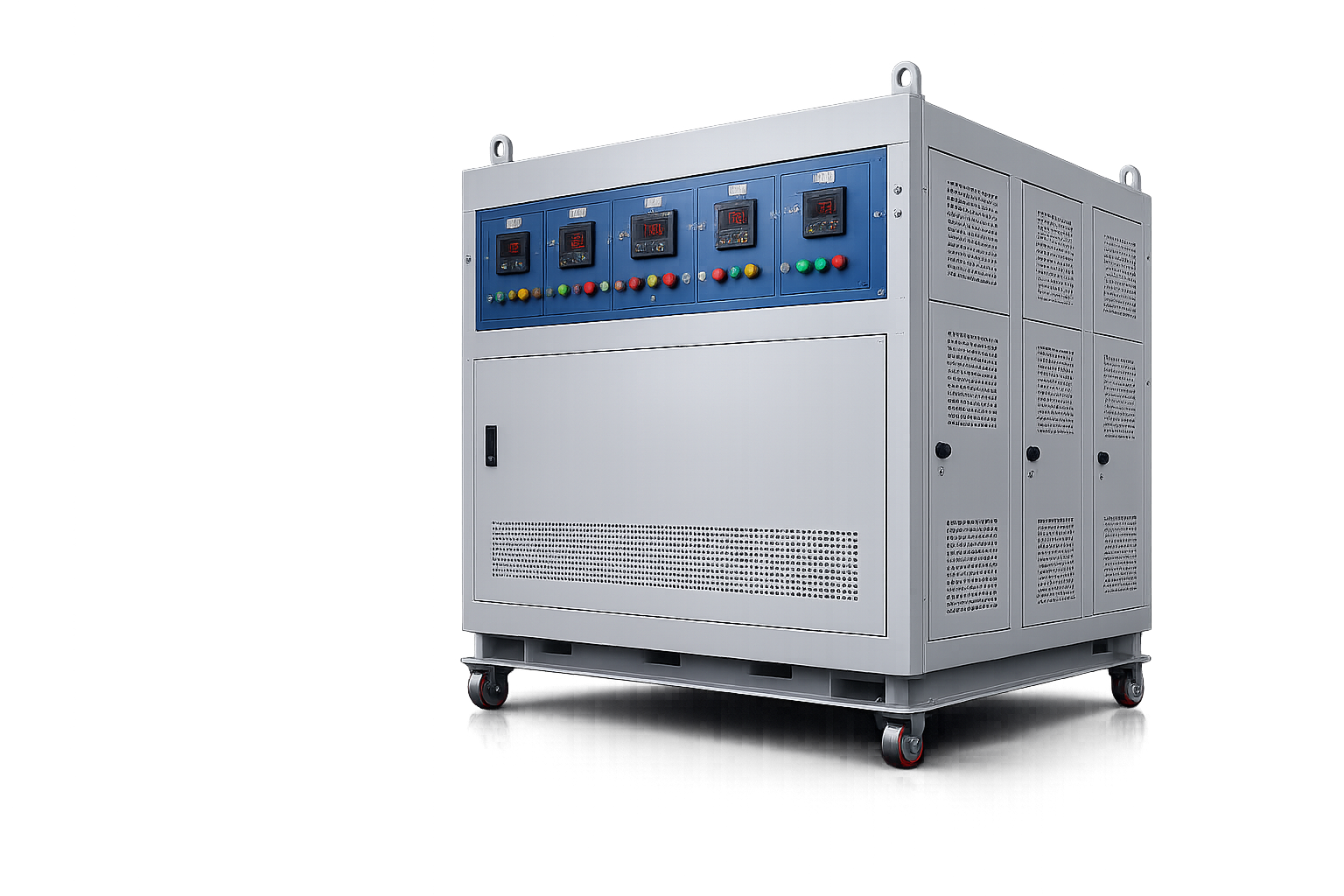
Why your lathe machine needs a servo stabilizer for lathe machine
Low voltage robs the spindle of torque, so the surface finish suffers, tools chatter and the motor overheats and trips on overload. On the Indian grid, voltage rarely sits at the rated value — it sags during peak demand and surges at night or when heavy loads switch off. Your lathe is built to run at a fixed voltage, and every excursion outside that window stresses insulation, overheats windings and ages electronics. A servo stabilizer for lathe machine sits between the mains and your equipment and holds the output steady at ±1%, no matter how wide the input swings. That single correction is what turns an unreliable supply into power your lathe machine can trust.
The servo stabilizer for lathe machine continuously senses the incoming voltage and drives a servo motor that adjusts a buck-boost transformer in real time. Correction is smooth and step-less at 25–40 volts per second, with no waveform distortion — so unlike a cheap relay-type stabilizer, it is safe for sensitive drives, controllers and PCBs. This is why a servo voltage stabilizer is the standard choice to protect a lathe machine rather than an ordinary stabilizer.
A servo stabilizer for lathe machine protects, in particular:
- main spindle motor
- feed and lead-screw drives
- coolant pump
- CNC / DRO controls
Signs you need a servo stabilizer for lathe machine
Most buyers look for a servo stabilizer for lathe machine only after the warning signs appear. If you recognise any of the symptoms below, your lathe machine is already at risk and a servo stabilizer will pay for itself quickly:
- Your lathe trips, restarts or shuts down whenever the mains voltage dips.
- Lights dim or flicker when the lathe or a nearby motor switches on.
- Repeated burnout of windings, PCBs, drives or contactors in your lathe machine.
- The lathe runs hot, hums or loses efficiency during peak-load hours.
- Your utility supply regularly swings outside the voltage your lathe machine is rated for.
Recommended servo stabilizer for lathe machine specification
For a typical lathe machine, we recommend a three phase air cooled unit in the 5–30 KVA range. The table below is the specification we build the servo stabilizer for lathe machine to — every value is configured to your actual site conditions and load.
| Application | Lathe Machines |
|---|---|
| Recommended Type | Three Phase Servo Voltage Stabilizer |
| Phase | Three Phase |
| Typical Capacity | 5–30 KVA |
| Output Voltage | 415V ±1% |
| Input Range | 340V–480V (3-ph) / 150V–270V (1-ph) |
| Cooling | Air Cooled |
| Output Accuracy | ±1% |
| Duty | 100% continuous |
How to choose the right KVA for your lathe machine
The most common question buyers ask is which KVA servo stabilizer for lathe machine they need. Add up the full-load rating of everything the stabilizer will feed, then add 20–25% headroom for motor-starting surges — that figure points to the KVA. Most lathe machine sites land in the 5–30 KVA band, but the right number depends on your exact connected load. We manufacture every rating to order, so the servo stabilizer for lathe machine is sized to your machine list, never an off-the-shelf compromise.
Popular capacities for this application include 5 KVA, 15 KVA, 30 KVA. Not sure which fits? Send us your load and we confirm the exact servo stabilizer for lathe machine rating the same day.
Features to look for in a servo stabilizer for lathe machine
Not every stabilizer is built for a demanding lathe machine. When you compare a servo stabilizer for lathe machine, check that it has the following — these are the features that separate a unit that lasts ten years from one that fails in two:
- Wide input window (typically 340V–480V three phase / 150V–270V single phase) so it corrects the real swings your site sees.
- True ±1% output accuracy — the standard a sensitive lathe machine actually needs.
- Double-wound, electrolytic-grade copper windings for low loss and long life.
- Fast correction (25–40 V/sec) with high & low cut-off and auto-restart protection.
- Air Cooled construction sized for 30 KVA continuous duty.
- Surge, overload and single-phasing protection with a bypass switch for servicing.
Benefits of a servo stabilizer for lathe machine
Installing the right servo stabilizer for lathe machine changes how your lathe machine runs from day one. The benefits are immediate and measurable:
- A precise ±1% output keeps your lathe machine running through every grid swing.
- Protects expensive main spindle motor from high- and low-voltage damage.
- Eliminates nuisance tripping, downtime and rejected production.
- Extends the service life of motors, drives, heaters and electronics.
- Cuts the energy waste and overheating caused by under- and over-voltage.
- Pays for itself by avoiding even one major equipment failure or lost batch.
Why buy your servo stabilizer for lathe machine from Servo Stabilizer India
We are a direct manufacturer of servo voltage stabilizers with over 22 years of experience and more than 18,000 stabilizers installed across India. Buying your servo stabilizer for lathe machine factory-direct means no dealer margin, a unit engineered to your exact lathe machine load, and a single point of accountability for supply, installation and service. Every servo stabilizer for lathe machine is built with copper windings, load-tested before dispatch, and backed by our own service engineers for installation, commissioning, warranty and AMC nationwide.
- ISO 9001:2015
- CE Certified
- BIS Approved
- MSME Registered
Explore the recommended Three Phase Servo Voltage Stabilizer, browse servo stabilizers by KVA, or see every model in our product range. New to sizing? Read our KVA selection guide and what is a servo stabilizer.